Understanding NIPT VS FTS
Deciding on prenatal screening tests can feel like navigating a complex landscape of medical terminology and personal choices. For expectant parents, understanding the available options is the first crucial step toward making informed decisions about their pregnancy journey.
These tests serve a vital purpose: to assess the risk of chromosomal abnormalities in the developing baby. It’s important to remember that these are screening tests, not diagnostic tools; they indicate the likelihood of a condition, not a definitive diagnosis.
One of the long-standing options for early assessment is First Trimester Screening (FTS). This combined approach involves two key components. First, a maternal blood test measures specific hormone levels, namely human chorionic gonadotropin (hCG) and pregnancy-associated plasma protein A (PAPP-A).
Second, a specialized ultrasound, known as a nuchal translucency (NT scan), measures the fluid accumulation at the back of the baby’s neck. These two data points are then used in conjunction with the mother’s age to calculate a risk assessment for conditions like Down syndrome (Trisomy 21) and Trisomy 18. FTS is typically performed between 11 and 14 weeks of pregnancy.
A more recent and increasingly popular option is Non-Invasive Prenatal Testing (NIPT). This advanced genetic test offers a significant leap in screening technology. How NIPT works is quite fascinating: it analyzes cell-free fetal DNA (cfDNA) that circulates in the mother’s blood.
This cfDNA originates from the placenta and carries genetic information about the baby. By examining this DNA, NIPT can screen for a range of chromosomal aneuploidies with remarkable accuracy. One of the key advantages of NIPT is its early accessibility; it can be performed as early as 10 weeks of pregnancy.
The core difference lies in the precision and methodology: NIPT provides a more direct and accurate assessment based on fetal genetic material compared to the indirect markers used in FTS.
Accuracy and Detection Rates: NIPT vs FTS Performance
When comparing prenatal screening options, the core discussion often revolves around their respective accuracy and detection rates. Understanding these figures is paramount for expectant parents to grasp the reliability of the results they receive. In the debate of NIPT vs FTS, the non-invasive prenatal test generally holds a significant advantage in terms of precision.
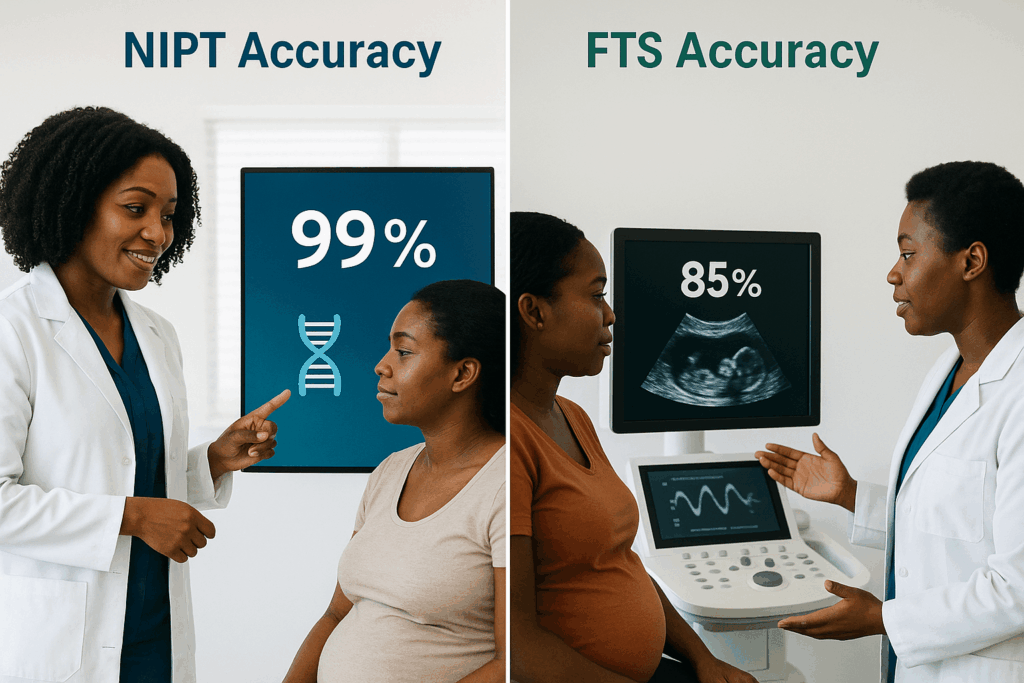
Let’s look at the numbers. The superior accuracy of NIPT is well-documented, particularly for common chromosomal abnormalities. For Down syndrome (Trisomy 21), NIPT boasts a detection rate of over 99%. This means it can identify nearly all cases of Trisomy 21.
It also maintains very high detection rates for Trisomy 18 (Edwards syndrome) and Trisomy 13 (Patau syndrome). Crucially, NIPT also has significantly lower false-positive rates, typically less than 1%. This translates to fewer instances where a test incorrectly indicates a high risk, thereby reducing unnecessary anxiety and avoiding recommendations for further invasive procedures.
In contrast, understanding FTS accuracy reveals a different picture. When combining both the blood test and the nuchal translucency (NT scan), First Trimester Screening achieves a detection rate for Down syndrome of approximately 90-96%.
While respectable, this is notably lower than NIPT. Furthermore, FTS has a higher false-positive rate, often around 5%. This means that roughly one in 20 pregnancies screened by FTS will show a high-risk result even when the baby does not have a chromosomal abnormality.
These false positives can be a source of considerable stress and often lead to recommendations for additional, potentially invasive, diagnostic testing.
Why does accuracy matter for next steps? The higher accuracy of NIPT can significantly reduce the need for subsequent invasive diagnostic procedures. If NIPT returns a low-risk result, it generally provides a high degree of reassurance, meaning there’s a much lower likelihood that invasive tests like amniocentesis or chorionic villus sampling (CVS) will be recommended.
This is a critical factor, as these diagnostic tests, while definitive, carry a small but real risk of complications, including miscarriage.
Therefore, NIPT often serves as a more reliable intermediate step, allowing families to make more informed decisions about whether to pursue further testing, thereby minimizing the need for more invasive prenatal diagnosis.
The clear advantage of NIPT vs FTS in this regard helps streamline the prenatal care pathway for many.
Don’t leave it to chance. Get the 99% accuracy of NIPT at our Lagos centre today.
Key Benefits of NIPT Over First Trimester Screening
Beyond accuracy, NIPT offers several compelling benefits that make it a preferred choice for many expectant parents when considering prenatal screening. These advantages often address concerns about timing, the need for invasive procedures, and the breadth of information provided.

One significant advantage is earlier detection and faster results with NIPT. While First Trimester Screening typically occurs between 11 and 14 weeks, NIPT can be performed as early as 10 weeks of pregnancy.
This earlier access to information can be incredibly reassuring for parents eager to understand their baby’s genetic health. Furthermore, the turnaround time for NIPT results is often quicker, usually within a few days to two weeks, compared to the potentially longer wait for comprehensive FTS results.
This efficiency in obtaining information can reduce the period of uncertainty and anxiety.
A major driver behind the adoption of NIPT is its ability to lead to a reduced need for invasive procedures.
As highlighted in the previous section, the lower false-positive rate of NIPT directly translates into fewer instances where a high-risk screening result prompts a recommendation for diagnostic tests like amniocentesis or chorionic villus sampling (CVS).
These invasive procedures, while offering definitive answers, carry a small but present risk of complications, including miscarriage.
By providing a highly accurate initial risk assessment, NIPT helps many families avoid these procedures and their associated risks, making the screening process safer and less stressful.
NIPT also stands out due to its broader scope of conditions screened. While FTS primarily screens for Down syndrome (Trisomy 21) and Trisomy 18, NIPT typically screens for a wider range of chromosomal aneuploidies.
This includes not only Trisomy 13 (Patau syndrome) but also common sex chromosome aneuploidies such as Turner syndrome (Monosomy X) and Klinefelter syndrome (XXY).
Some advanced NIPT panels can even screen for certain microdeletions, which are smaller missing pieces of chromosomes associated with specific genetic conditions. This comprehensive screening makes NIPT a more powerful tool for detecting a wider array of genetic concerns compared to the more limited focus of FTS.
Finally, a fundamental benefit is that NIPT is non-invasive and safe. It requires only a simple maternal blood draw, posing no risk to the developing fetus. This contrasts with FTS, which, while also safe, includes an ultrasound component.
The simplicity and safety of the blood draw make NIPT a comfortable and stress-free option for genetic screening, reinforcing its appeal for expectant parents seeking reliable information without compromising the pregnancy.
Disadvantages and Limitations: NIPT Compared to FTS
While NIPT offers significant advantages, it’s equally important for expectant parents to be aware of its limitations and potential drawbacks. Understanding these aspects allows for a balanced perspective when weighing NIPT vs. FTS and making the best choice for their individual circumstances.

One of the most notable considerations is the cost of NIPT. Generally, NIPT is more expensive than First Trimester Screening. The exact cost can vary widely depending on the provider and the specific panel of conditions screened.
Furthermore, insurance coverage for NIPT can be inconsistent. While many insurance plans now cover NIPT for high-risk pregnancies (e.g., those with advanced maternal age or a family history of chromosomal abnormalities), coverage for low-risk pregnancies is not universal and can be a significant out-of-pocket expense.
It’s crucial for patients to verify their specific insurance benefits and discuss potential costs with their healthcare provider.
It’s vital to reiterate that NIPT is a screening test, not diagnostic. Despite its very high accuracy, a positive NIPT result does not definitively confirm a chromosomal abnormality. It only indicates a significantly increased risk.
Therefore, any positive NIPT finding still requires confirmation through an invasive diagnostic procedure, such as chorionic villus sampling (CVS) or amniocentesis. This distinction is critical to avoid misinterpreting NIPT results as a final diagnosis.
NIPT also has limitations in certain cases. Its accuracy can be reduced in multiple pregnancies, such as twins or triplets, due to the presence of DNA from more than one fetus.
There’s also a possibility of receiving a “no result” or “inconclusive” finding, often due to a low fetal fraction—the proportion of fetal DNA in the mother’s blood. This can happen in very early gestation or in cases of high maternal body mass index (BMI).
Furthermore, while comprehensive, NIPT does not screen for all chromosomal or structural abnormalities. It primarily focuses on common aneuploidies and select microdeletions; it won’t detect all rare genetic conditions or physical birth defects that an ultrasound (part of FTS) might indirectly indicate.
NIPT may also miss rare mosaic conditions, where only some cells in the baby have an extra or missing chromosome.Finally, there are ongoing ethical considerations of NIPT.
The widespread availability of highly accurate prenatal screening tests like NIPT has spurred discussions about informed consent, the potential for increased elective terminations based on non-life-threatening conditions, and broader societal implications regarding disability.
These are complex ethical discussions that contribute to the comprehensive landscape of prenatal decision-making.
Deciding Which Test is Right for You: NIPT vs FTS
Choosing between NIPT and First Trimester Screening is a highly personal decision, and there’s no single “best” option for every expectant parent. The right choice hinges on a combination of individual circumstances, priorities, and discussions with your healthcare provider.
When considering which test to pursue, several factors come into play. Your individual risk factors are paramount: maternal age (as the risk of certain conditions increases with age), any family history of chromosomal abnormalities, or previous abnormal screening results could influence the recommendation.
Your personal preference for accuracy versus cost is also a key differentiator. Are you willing to pay more for higher accuracy and potentially reduce the need for invasive procedures? Or is a more affordable option that provides a general risk assessment sufficient? Your desire for early information also matters; NIPT offers earlier screening compared to FTS.
Finally, your comfort level with potential false positives and the possibility of follow-up invasive procedures should be carefully weighed, understanding that FTS has a higher false-positive rate than NIPT.
This is where the essential role of your healthcare provider becomes critical. It is highly recommended to have a thorough discussion with your OB/GYN or a genetic counselor. They can provide personalized recommendations based on your unique medical history, family background, and any specific concerns you might have.
They can explain the nuances of each test, interpret preliminary risk factors, and help you understand the implications of different results. This guidance is invaluable in navigating the complexities of prenatal screening and making an informed choice for your specific pregnancy.
For some, a combined approach—FTS and contingent NIPT—presents a viable strategy. This pathway involves performing the First Trimester Screening first. If the FTS results indicate an increased risk for a chromosomal abnormality, then NIPT is subsequently offered as a contingent or follow-up test.
This can be a cost-effective approach for many families, as it only utilizes the more expensive NIPT if the initial FTS suggests a higher likelihood of an issue, thereby avoiding unnecessary NIPT costs for those with low-risk FTS results.
This strategy balances accuracy with financial considerations, offering a practical solution for weighing NIPT versus FTS.
Conclusion
Navigating the landscape of prenatal screening options, particularly the decision between NIPT and FTS, can feel overwhelming. However, by understanding the fundamental differences and benefits of each, expectant parents can make empowered choices about their pregnancy journey.
Both Non-Invasive Prenatal Testing (NIPT) and First Trimester Screening (FTS) are valuable tools designed to provide early information about the risk of chromosomal abnormalities.
The key takeaways highlight that while both are effective screening methods, NIPT generally offers superior accuracy, especially for common aneuploidies like Down syndrome, and a lower false-positive rate.
It also provides earlier results and is non-invasive, relying simply on a maternal blood draw. FTS, a combined blood test and ultrasound, remains a well-established and valuable option, particularly given its lower cost and the visual information provided by the NT scan.
Each test serves a distinct purpose, and neither is universally “better” for every individual.
Regardless of the screening path chosen, the importance of comprehensive counseling cannot be overstated. Engaging in pre-test and post-test genetic counseling is crucial. These sessions allow individuals to fully understand the implications of the results, discuss any concerns, and explore potential next steps, including the option of diagnostic testing if a high risk is indicated.
Ultimately, preparing for your pregnancy journey involves proactive engagement in decisions about your prenatal care.
By familiarizing yourself with the distinctions between NIPT and FTS, discussing your personal risk factors and preferences with your healthcare provider, and utilizing available counseling resources, you can confidently make the choices that feel right for you and your growing family.
FAQ
What is the main difference between NIPT and FTS?
The main difference is accuracy and what they test. NIPT (Non-Invasive Prenatal Testing) is a blood test that directly analyzes fetal DNA in the mother’s blood, offering over 99% accuracy for common trisomies like Down syndrome. FTS (First Trimester Screening) combines a blood test with an ultrasound (NT scan) and has a lower detection rate, around 90-96%, with a higher false-positive rate. Essentially, NIPT provides a more precise screening.
Is NIPT covered by insurance?
Insurance coverage for NIPT varies widely. Many insurance plans cover NIPT for high-risk pregnancies (e.g., advanced maternal age, history of chromosomal abnormalities). Coverage for low-risk pregnancies is becoming more common but is not universal. It’s crucial to check with your insurance provider and discuss costs with your healthcare team.
Can NIPT tell me the gender of my baby?
Yes, since NIPT analyzes sex chromosomes (X and Y), it can accurately determine the baby’s gender with very high accuracy as early as 10 weeks of pregnancy. However, some NIPT tests do not automatically disclose gender unless specifically requested.
If my NIPT results are positive, does that mean my baby definitely has a chromosomal abnormality?
No. NIPT is a highly accurate screening test, but it is not diagnostic. A positive NIPT result indicates a high risk, but it does not confirm a diagnosis. Any positive NIPT result should be confirmed with a diagnostic test, such as chorionic villus sampling (CVS) or amniocentesis, to get a definitive answer.
Are there any risks associated with NIPT or FTS?
Both NIPT and FTS are considered very safe for both the mother and baby. NIPT only requires a maternal blood draw, posing no risk to the fetus. FTS involves a blood test and an ultrasound, which are also safe. The potential “risk” lies in false-positive results from FTS, which can lead to unnecessary anxiety and consideration of invasive diagnostic procedures that carry a small risk of miscarriage.